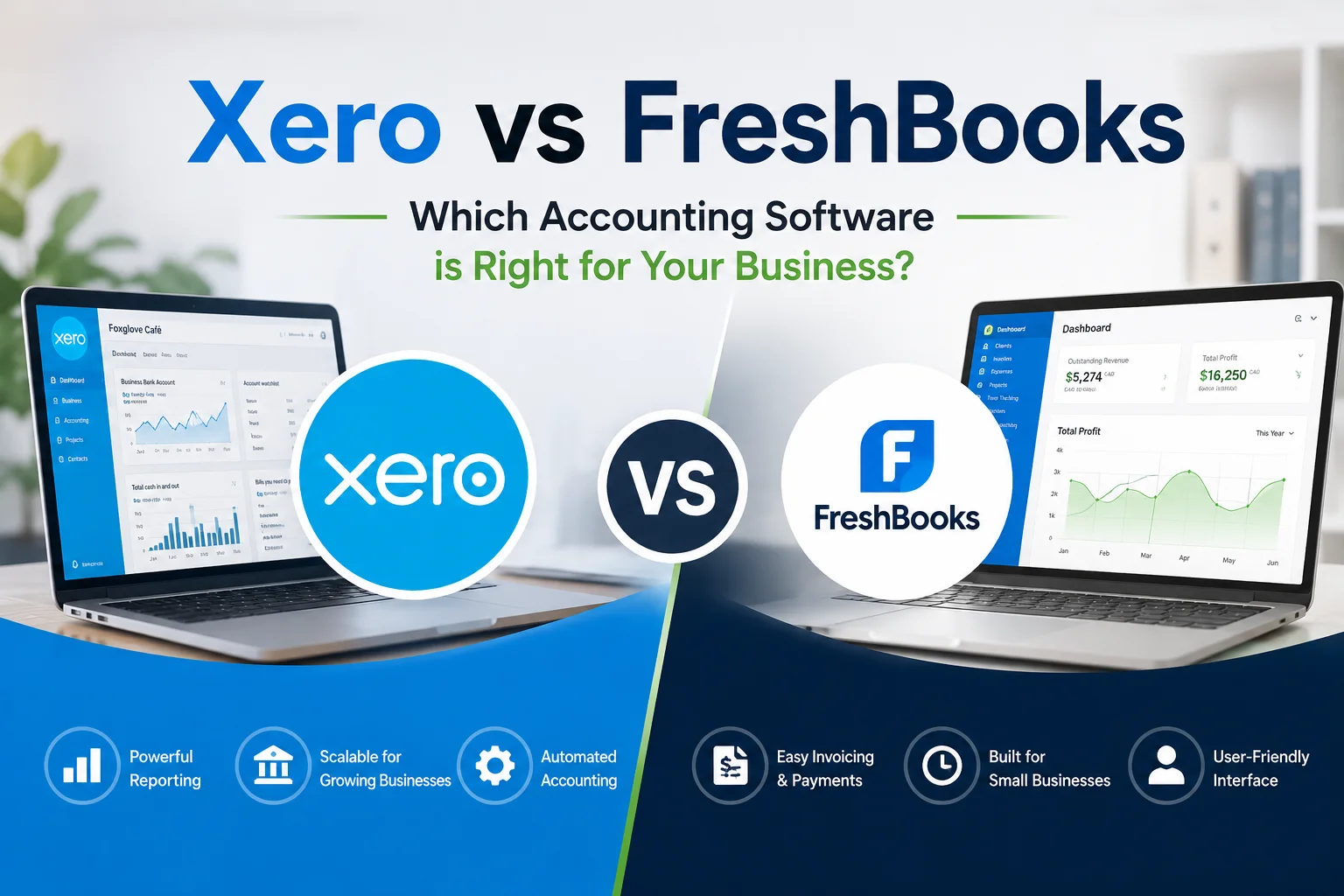
Xero vs FreshBooks: Which One Offers Better Value in 2026?
Selecting the right accounting software is no longer just about bookkeeping. In 2026, business owners expect their accounting platform to help manage invoicing, cash flow, expenses, reporting, taxes, and team collaboration—all while saving time and reducing manual work.
Among the most popular cloud accounting solutions available today are Xero and FreshBooks. Both platforms are designed to simplify financial management for small businesses, freelancers, startups, and growing companies. However, while they share many similarities, they serve slightly different audiences and offer different levels of functionality.
If you’re trying to decide between Xero and FreshBooks, this detailed comparison will help you understand which platform provides better value for your business in 2026.
Quick Verdict
If you’re short on time, here’s the simple answer:
Choose Xero If:
- You run a growing business.
- You need unlimited users.
- You work with an accountant or bookkeeping team.
- You require advanced accounting features.
- You want stronger reporting and scalability.
- You operate internationally.
Choose FreshBooks If:
- You’re a freelancer or consultant.
- Invoicing is your primary need.
- You manage a small number of clients.
- You want the simplest possible accounting software.
- You prioritize ease of use over advanced accounting tools.
For most startups and small businesses planning long-term growth, Xero delivers significantly more value. FreshBooks excels in invoicing and client management but lacks some of the deeper accounting capabilities that growing businesses often require.
Understanding the Difference Between Xero and FreshBooks
Before comparing features, it’s important to understand how these platforms were originally designed.
Xero’s Focus
Xero was built as a complete cloud accounting platform.
Its goal is to provide businesses with everything needed to manage finances, including:
- Accounting
- Bookkeeping
- Reporting
- Payroll integrations
- Bank reconciliation
- Inventory tracking
- Multi-currency accounting
- Team collaboration
Xero is designed for businesses that need more than just invoicing.
FreshBooks’ Focus
FreshBooks started primarily as an invoicing solution for freelancers and service professionals.
Over time, it evolved into a broader accounting platform, but its strongest features still revolve around:
- Invoicing
- Time tracking
- Client billing
- Project management
- Expense tracking
Because of this background, FreshBooks remains particularly popular among freelancers, consultants, agencies, and independent professionals.
Pricing Comparison
Pricing plays a major role when choosing accounting software.
At first glance, FreshBooks may appear affordable. However, businesses should look beyond monthly subscription costs and consider long-term value.
Xero Pricing
Xero offers several plans designed for different business sizes.
Depending on the plan, users gain access to:
- Unlimited users
- Bank reconciliation
- Online invoicing
- Reporting tools
- Expense tracking
- Inventory management
- Project tracking
- Multi-currency support
One of Xero’s biggest advantages is that it does not charge extra simply because your team grows.
FreshBooks Pricing
FreshBooks offers multiple plans based largely on the number of billable clients and advanced features.
Higher-tier plans unlock:
- More clients
- Advanced reporting
- Team collaboration
- Project profitability tools
Additional users often increase overall costs.
Winner: Xero
Although FreshBooks can be affordable for solo professionals, Xero generally offers stronger value for businesses that expect to grow and add team members.
Ease of Use
Accounting software should simplify financial management rather than create additional complexity.
FreshBooks User Experience
FreshBooks is widely recognized as one of the easiest accounting platforms available.
The interface is clean, intuitive, and beginner-friendly.
Even users with no accounting experience can quickly:
- Create invoices
- Track expenses
- Send estimates
- Manage projects
Many freelancers choose FreshBooks specifically because of its simplicity.
Xero User Experience
Xero also provides an excellent user experience.
While it includes more accounting functionality than FreshBooks, the platform remains easy to navigate.
The dashboard offers clear visibility into:
- Cash flow
- Outstanding invoices
- Bank balances
- Financial performance
There may be a slightly steeper learning curve than FreshBooks, but most users adapt quickly.
Winner: FreshBooks
For pure ease of use, FreshBooks has a slight advantage.
Invoicing Features
For many businesses, invoicing directly impacts cash flow and profitability.
Both platforms offer strong invoicing capabilities, but there are some important differences.
FreshBooks Invoicing
This is where FreshBooks truly shines.
Features include:
- Professional invoice templates
- Recurring invoices
- Automatic payment reminders
- Online payment collection
- Estimates and proposals
- Client portals
FreshBooks was built around invoicing, and it shows.
Xero Invoicing
Xero also offers powerful invoicing functionality.
Users can:
- Create custom invoices
- Send recurring invoices
- Track payment status
- Automate reminders
- Accept online payments
While highly capable, Xero’s invoicing tools are slightly less specialized than FreshBooks.
Winner: FreshBooks
Freelancers and service providers may appreciate FreshBooks’ invoicing-focused design.
Bank Reconciliation
One of the most time-consuming bookkeeping tasks is reconciling bank transactions.
This is an area where Xero consistently receives praise from accountants and business owners.
Xero
Xero’s reconciliation engine automatically imports bank transactions and suggests matches.
This reduces manual data entry and saves considerable time.
Businesses handling hundreds or thousands of transactions each month benefit significantly from this automation.
FreshBooks
FreshBooks supports bank connections and transaction categorization.
However, its reconciliation process is generally less advanced compared to Xero.
Winner: Xero
For bookkeeping efficiency, Xero clearly takes the lead.
Financial Reporting
As businesses grow, financial reporting becomes increasingly important.
Owners need access to accurate data to make informed decisions.
Xero Reporting
Xero includes:
- Profit and loss reports
- Balance sheets
- Cash flow statements
- Budget reports
- Tax summaries
- Financial dashboards
Reports are professional, detailed, and suitable for growing businesses.
FreshBooks Reporting
FreshBooks offers useful reports including:
- Revenue reports
- Expense reports
- Tax summaries
- Accounts aging reports
While useful, reporting is not as comprehensive as Xero.
Winner: Xero
Businesses seeking deeper financial insights will benefit from Xero’s reporting capabilities.
Inventory Management
Inventory management is essential for product-based businesses.
Xero
Xero includes built-in inventory tracking features.
Users can:
- Monitor stock levels
- Track product costs
- Manage inventory items
For more advanced inventory needs, Xero integrates with specialized inventory platforms.
FreshBooks
FreshBooks offers limited inventory functionality.
It is primarily designed for service-based businesses rather than product sellers.
Winner: Xero
Retailers, wholesalers, and e-commerce businesses will find Xero significantly more useful.
Multi-User Collaboration
As companies grow, multiple people often need access to accounting data.
This may include:
- Owners
- Accountants
- Bookkeepers
- Managers
- Team members
Xero
One of Xero’s most attractive features is unlimited users across subscription plans.
Businesses can collaborate without worrying about additional user fees.
FreshBooks
FreshBooks charges for additional users and team members.
Costs can increase as organizations expand.
Winner: Xero
For startups and SMEs, unlimited users represent a major advantage.
Project Management and Time Tracking
This is one category where FreshBooks performs exceptionally well.
FreshBooks
FreshBooks includes:
- Built-in time tracking
- Project budgeting
- Team collaboration
- Project profitability reporting
These tools are particularly valuable for:
- Consultants
- Marketing agencies
- Designers
- Freelancers
- Service providers
Xero
Xero offers project tracking through higher-tier plans but is not as project-focused as FreshBooks.
Winner: FreshBooks
Service businesses may appreciate FreshBooks’ stronger project management capabilities.
Integrations and Ecosystem
Most businesses rely on multiple software tools.
Integration support therefore plays an important role.
Xero
Xero connects with over a thousand business applications, including:
- Shopify
- Stripe
- PayPal
- HubSpot
- Square
- Gusto
- Zapier
Its integration marketplace is among the largest in the accounting software industry.
FreshBooks
FreshBooks integrates with many popular tools but offers a smaller ecosystem compared to Xero.
Winner: Xero
Businesses seeking flexibility will appreciate Xero’s extensive integrations.
International Business Support
Modern businesses often serve customers globally.
Xero
Xero offers robust support for international operations through:
- Multi-currency accounting
- Global tax support
- International payment integrations
These features make it suitable for businesses operating across borders.
FreshBooks
FreshBooks supports international invoicing and payments but lacks some of the deeper international accounting capabilities found in Xero.
Winner: Xero
For global businesses, Xero is the stronger choice.
Customer Support
Both providers offer customer support resources.
FreshBooks
FreshBooks is known for responsive customer service and a helpful support team.
Support options include:
- Phone support
- Knowledge base
- Webinars
Xero
Xero focuses primarily on:
- Online support
- Ticket systems
- Help center resources
- Community forums
Winner: FreshBooks
Businesses that value direct support may prefer FreshBooks.
Which Platform Is Better for Freelancers?
Freelancers often prioritize:
- Invoicing
- Time tracking
- Simplicity
- Client management
For these needs, FreshBooks remains one of the strongest options available.
Its workflow was specifically designed around serving independent professionals.
Best Choice for Freelancers: FreshBooks
Which Platform Is Better for Startups and SMEs?
Growing businesses typically require:
- Multiple users
- Strong reporting
- Scalability
- Advanced accounting
- Integration flexibility
These are areas where Xero consistently outperforms FreshBooks.
As businesses grow, they often need accounting software that can handle increasing complexity without requiring a platform migration.
Best Choice for Startups and SMEs: Xero
Final Verdict: Xero vs FreshBooks
Both Xero and FreshBooks are excellent cloud-based accounting solutions, but they target different audiences.
Choose FreshBooks If:
- You’re a freelancer.
- You primarily invoice clients.
- You need built-in time tracking.
- Simplicity is your top priority.
Choose Xero If:
- You’re building a growing business.
- You need unlimited users.
- You require advanced accounting capabilities.
- You want stronger reporting.
- You manage inventory.
- You need international business support.
When evaluating overall value in 2026, Xero emerges as the stronger long-term investment for most startups and small businesses. While FreshBooks remains one of the best solutions for freelancers and service professionals, Xero offers a more complete accounting platform capable of supporting businesses through every stage of growth.
If you’re looking for accounting software that can grow with your company while providing excellent collaboration, reporting, automation, and financial management tools, Xero is the better choice for most businesses.